Bay Area Residents Awakened by Early-Morning Magnitude 4.6 Earthquake Near Boulder Creek
A jolt before dawn across the Bay Area
Millions of people across California’s Bay Area were jolted awake early Thursday when an earthquake struck south of San Francisco. The shaking arrived in the middle of the night, a time when even moderate tremors can feel more startling because they interrupt sleep and leave residents searching for quick information in the dark.
Despite the widespread wake-up call, there were no reports of significant damage in the immediate aftermath. That early assessment helped set the tone for the hours that followed: a region briefly rattled, then quickly shifting into the familiar routine of checking details, comparing experiences, and watching for updates.
What happened: time, location, and magnitude
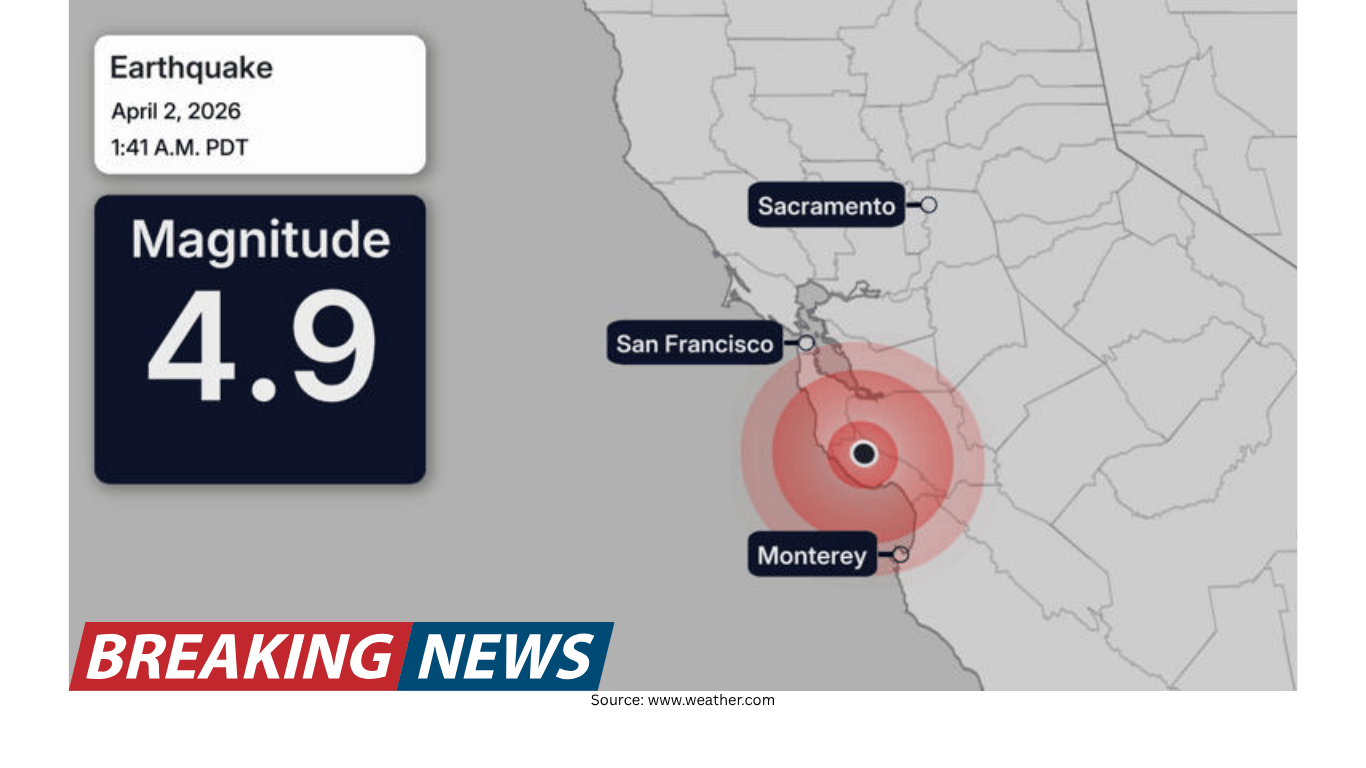
The earthquake was reported at 1:41 a.m. local time (4:41 a.m. EDT). According to the U.S. Geological Survey (USGS), the tremor measured magnitude 4.6 and was located just outside of Boulder Creek, California. Boulder Creek sits about 60 miles south of San Francisco, placing the epicenter within a part of the broader Bay Area region where residents are accustomed to living with seismic risk.
The USGS described the quake as shallow, reportedly less than 7 miles below the surface. Shallow earthquakes can often be felt over a wide area, and in this case, the shaking was widely reported. For many people, the first sign of the event was not a news alert or a phone notification, but the movement itself—followed moments later by the scramble to confirm what had happened.
Initial impact: no significant damage reported
In the hours after the quake, there were no reports of significant damage. The USGS said the risk of major damage or deaths was low, and, as of the early updates, neither had been reported.
That does not mean the quake was insignificant to those who felt it. A magnitude 4.6 event can be strong enough to wake people up, rattle homes, and spark immediate concern—especially in a region where residents understand that even a modest quake can be followed by additional shaking. Still, the early lack of major damage reports suggested the event was more disruptive than destructive.
How widely it was felt: a region reacts in real time
The shaking was felt widely, and the public response unfolded quickly. Many residents reached for their phones to share what they experienced. Social media posts reflected a familiar pattern during overnight earthquakes: people confirming that others felt it too, comparing how strong it seemed in different neighborhoods, and noting whether they received alerts.
In modern earthquakes, the public’s real-time reaction often becomes part of the story. The immediate sharing of experiences can help illustrate the quake’s reach, particularly when people across a large region report being awakened or startled by the same event. In this case, the broad sense of surprise was amplified by the timing: 1:41 a.m. local time, when most of the Bay Area was asleep.
Earthquake alerts: what residents received and when
Many Bay Area residents received earthquake alerts. As reported by the San Francisco Chronicle, these alerts are sent for earthquakes of magnitude 4.5 and above. With the quake measured at 4.6, it met that threshold.
However, the timing of alerts can vary depending on proximity to the epicenter. In Boulder Creek, the Chronicle noted, the alerts came after the shaking began—an outcome that was described as unsurprising given the location’s closeness to where the quake was reported. That detail underscores a key reality of earthquake warning systems: alerts may provide more lead time for people farther away than for those near the epicenter, where shaking can arrive quickly.
Even when an alert arrives after shaking starts, it can still serve a purpose by confirming that an earthquake has occurred and by signaling that additional information may follow. For people awakened abruptly, that confirmation can be reassuring, even if it comes moments late.
Aftershocks: what the USGS estimates for the coming week
As with many earthquakes, attention quickly turned to the possibility of aftershocks. The USGS estimated there is a 56% chance of a magnitude 3 or higher aftershock in the next week. At the same time, the agency estimated only a 1% chance of a tremor stronger than 4.9 during that same time frame.
Those estimates provide a framework for what residents might expect: a meaningful possibility of smaller aftershocks, but a relatively low likelihood—based on the USGS estimate—of something stronger than 4.9 in the week ahead. Aftershocks can be unsettling, particularly when they occur soon after the main quake, and they may be felt as sharp jolts or brief rolling motions depending on location and depth.
Why depth and location matter to what people feel
The USGS described the quake as shallow, reportedly less than 7 miles below the surface. Depth is one of the factors that can shape how an earthquake is experienced at ground level. While the magnitude indicates the size of the quake, depth can influence how strongly the shaking is felt nearby and how far it may be noticed.
In this case, the quake’s location—just outside Boulder Creek—placed it within reach of a large population center. With San Francisco about 60 miles to the north, the event sat close enough to be felt across a wide area, contributing to the reports of millions being awakened.
A familiar pattern in earthquake country
For Bay Area residents, the sequence of events was familiar: a sudden wake-up, a quick search for details, alerts sounding for some, and social media filling with accounts from people across the region. The early message from officials and the USGS—low risk of major damage or deaths, and no significant damage reported so far—helped provide context amid the immediate uncertainty.
Still, even when impacts are limited, overnight earthquakes can leave a lingering sense of unease. People may find themselves listening for creaks in the house, checking messages from friends and family, or staying up longer than planned. The possibility of aftershocks, particularly in the first hours and days, can keep attention focused on updates.
Key details at a glance
Time: 1:41 a.m. local time (4:41 a.m. EDT)
Magnitude: 4.6
Location: Just outside Boulder Creek, California, about 60 miles south of San Francisco
Depth: Shallow, reportedly less than 7 miles below the surface
Immediate reports: No significant damage reported so far
USGS risk assessment: Risk of major damage or deaths was low; neither had been reported
Aftershock outlook: USGS estimates a 56% chance of a magnitude 3+ aftershock in the next week; a 1% chance of a tremor stronger than 4.9 in that period
Alerts: Earthquake alerts go out for magnitude 4.5 and above; near Boulder Creek, alerts arrived after shaking began
What comes next: monitoring and awareness
With no significant damage reported, the focus in the wake of the quake centers on monitoring for aftershocks and staying aware of official updates. The USGS probabilities suggest that additional smaller quakes are plausible within the next week, even as the chance of a stronger event—above 4.9—was estimated to be low.
For residents who felt the shaking, the experience serves as a reminder of how quickly the ground can move and how widely a moderate earthquake can be felt across a densely populated region. In the immediate term, the Bay Area’s early-morning quake appears to have been a sharp interruption rather than a damaging disaster—one that nevertheless reached millions, triggered alerts, and set off a wave of overnight reactions across the region.