Oceans, Heat and the Rising Stakes for Weather Forecasting
Oceans are absorbing record heat — and the atmosphere is responding
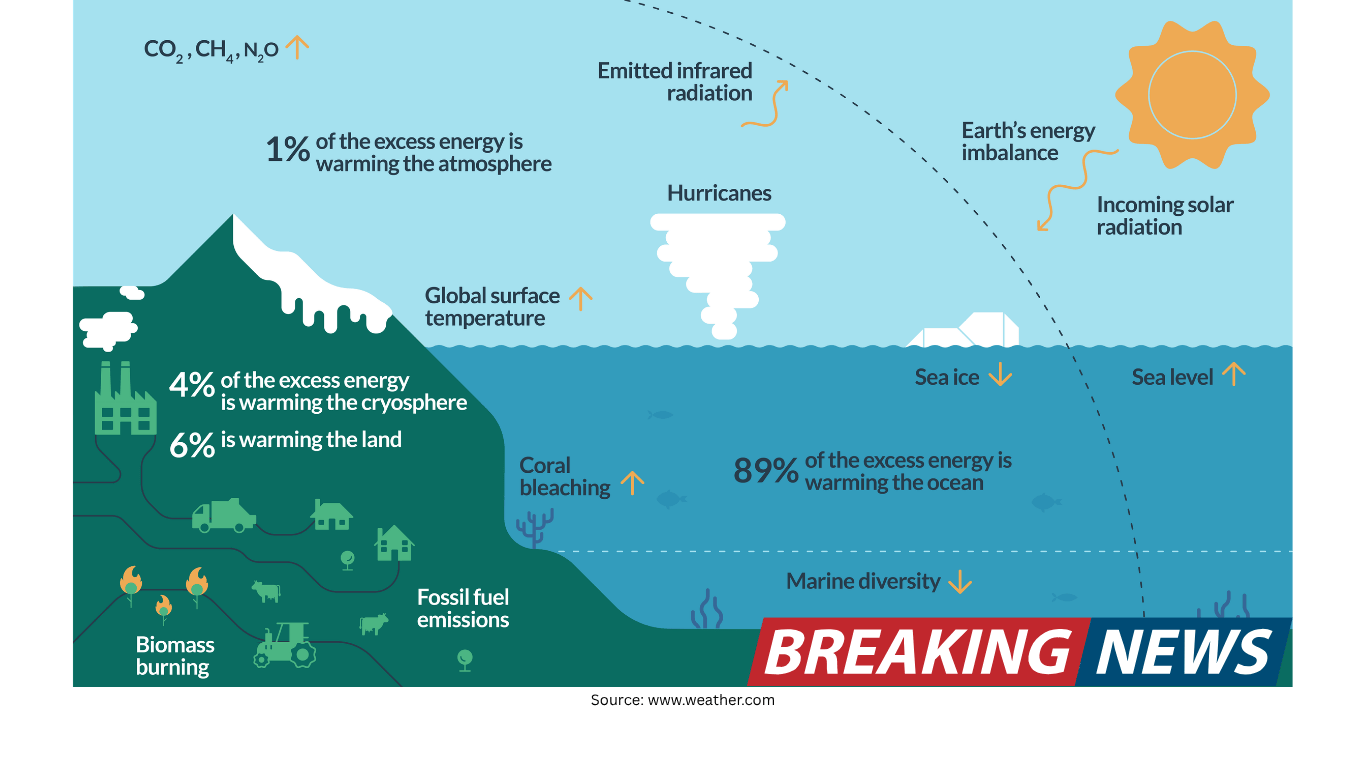
A new study has drawn attention to a major development in the planet’s climate system: in 2025, Earth’s oceans absorbed more heat than ever before. While the ocean is often discussed as a stabilizing force because it can store enormous amounts of energy, the study underscores a more urgent reality as well. When the ocean takes up exceptional levels of heat, the effects do not stay confined to the water. That stored energy can influence the air above it, altering conditions in ways that can contribute to extreme weather around the world.
The study’s core message is straightforward but consequential. Oceans are not just passive backdrops to weather; they are active participants. When they absorb heat at record levels, that heat can help “supercharge” the atmosphere. In practical terms, this means the atmosphere may have more energy available to drive weather systems, and the consequences can show up in many regions rather than being limited to one coastline or one ocean basin.
Why ocean heat matters to weather, not just climate
Weather forecasting is often described in terms of what happens in the atmosphere: shifting pressure patterns, moisture transport, winds, and storms. But the study highlighted in the video points to the ocean as a critical part of the equation, especially when it is absorbing unprecedented heat. The ocean and atmosphere are tightly linked, trading heat and moisture back and forth. When the ocean stores more heat than usual, it can change that exchange.
The implication is not simply that the planet is warmer. It is that the atmosphere can be energized by the ocean’s heat in ways that support more intense or more disruptive events. The study described the ocean’s heat absorption as aiding extreme weather “all over the world,” emphasizing the global reach of this mechanism.
“Supercharging” the atmosphere: what the study is pointing to
The study’s language — that ocean heat absorption is “supercharging” the atmosphere — is a way of describing an increase in the energy available to atmospheric processes. In the context provided, the key idea is that record ocean heat does not remain isolated. Instead, it can influence the atmosphere and help create conditions that are more favorable for extreme weather.
This does not mean that every weather event becomes extreme, or that one single factor explains every storm, flood, or heat episode. Rather, the study suggests that when oceans absorb extraordinary amounts of heat, it can tilt the background conditions in a direction that supports extremes. That shift in baseline conditions is what makes the finding notable for anyone trying to understand why extreme weather may be occurring across different parts of the world.
What the video emphasizes: how much heat the oceans are absorbing and the consequences
The video accompanying the study focuses on two main points: the scale of heat the oceans are taking in, and what that means for impacts. The framing is not limited to a technical discussion of measurements. Instead, it connects the record heat absorption to real-world outcomes — specifically, the way this heat can contribute to extreme weather globally.
By centering the discussion on ocean heat, the report reinforces an important perspective for the public: the ocean is a massive heat reservoir, and changes in how it stores heat can have consequences that are felt in the atmosphere. The video’s promise to show “how much heat the oceans are absorbing” and “what the consequences are” reflects an effort to translate a scientific finding into a broader understanding of risk.
How this changes the way people may think about forecasts
For everyday audiences, forecasts are often judged on immediate outcomes: Will it rain? Will it be hot? Will there be severe storms? The study’s finding adds context to those day-to-day questions. If the oceans are absorbing more heat than ever before, the atmosphere is operating with a different energy balance than in years when ocean heat uptake was lower. That matters because forecasting is ultimately about anticipating how the atmosphere will behave under current conditions.
In that sense, the study can be read as a reminder that the “starting point” for weather can shift. When background conditions are altered by record ocean heat, the atmosphere may be more primed for extremes. This does not replace traditional forecasting tools, but it does help explain why meteorologists and researchers pay close attention to the ocean when assessing potential for significant weather.
Extreme weather “all over the world”: a global signal, not a local anomaly
One of the most striking elements in the description is the breadth of the impact: the heat absorption is described as aiding extreme weather “all over the world.” That phrasing matters. It suggests the study is not focused on a single region’s unusual season or a short-lived local pattern. Instead, it points toward a broader global influence that can manifest in different ways depending on location and season.
In practical terms, this global framing helps explain why discussions of ocean heat can appear alongside very different weather stories. The ocean’s role is systemic. When it absorbs heat at record levels, it can affect the atmosphere in ways that may influence a wide variety of extreme events, even if those events look different from place to place.
What this means for travelers and tourist destinations
For travelers, the relationship between ocean heat and extreme weather is not an abstract issue. Many tourist destinations are closely tied to coastal environments, island climates, and seasonal weather patterns. When the study describes ocean heat absorption as supercharging the atmosphere and aiding extreme weather worldwide, it raises practical questions for people planning trips: How stable are typical seasonal expectations? How often might conditions deviate from what travelers consider “normal”?
It is important to keep the study’s scope in mind. The provided information does not list specific destinations, hazards, or timelines beyond the reference to 2025 and the global influence on extremes. Still, the general takeaway is relevant for tourism: if the atmosphere is being energized by record ocean heat, the potential for disruptive weather can become a more prominent factor in travel planning, especially in regions where weather is already a key part of the experience.
Key ideas highlighted by the study
In 2025, Earth’s oceans absorbed more heat than ever before, according to the study referenced in the video.
This record heat absorption is described as “supercharging” the atmosphere.
The study links this process to extreme weather occurring around the world.
The accompanying video focuses on the scale of ocean heat absorption and the consequences that can follow.
Understanding the ocean’s role without oversimplifying it
The study’s conclusion, as described, is powerful: record ocean heat absorption is aiding extreme weather globally. At the same time, it is worth approaching this kind of finding with a careful mindset. Weather is complex, and extreme events often involve multiple contributing factors. The value of the study, based on the information provided, is that it highlights one major driver — ocean heat — that can influence the atmosphere’s capacity to produce extremes.
In other words, the ocean’s heat uptake can be understood as part of the broader set of conditions that shape weather outcomes. The study’s emphasis on the ocean is a reminder that what happens beneath the surface can matter greatly for what happens in the sky.
Why the focus on “consequences” matters
The video’s emphasis on consequences signals that this is not just a technical milestone about measurement records. The central point is impact: if the oceans are absorbing unprecedented heat, and that heat is energizing the atmosphere, then the outcomes can be felt through extreme weather. That framing is especially important for public understanding because it connects a large-scale physical process to the kinds of events that affect communities, infrastructure, and daily life.
Even without listing specific events, the description makes a clear causal chain: record ocean heat absorption contributes to atmospheric changes, and those changes support extreme weather globally. The “consequences” are therefore tied to the increased potential for extremes, which can carry a wide range of practical implications depending on where and when they occur.
What to watch for in future discussions of ocean heat and forecasts
As attention to ocean heat continues, the study referenced here provides a lens for interpreting future weather coverage. When meteorologists and researchers discuss the ocean’s heat content or the way the ocean is interacting with the atmosphere, they are often pointing to the same underlying idea highlighted in this report: the ocean can store enormous energy, and changes in that stored energy can influence the atmosphere’s behavior.
The study’s focus on 2025 as a record year for ocean heat absorption also suggests that tracking ocean heat is not merely academic. It can be part of understanding the broader environment in which weather systems develop. For audiences trying to make sense of extreme weather stories from different parts of the world, ocean heat can serve as a unifying concept — a global factor that can help explain why the atmosphere may be more capable of producing extremes.
A takeaway grounded in the study’s central finding
The most important point from the provided information is the study’s finding that Earth’s oceans absorbed more heat than ever before in 2025, and that this heat absorption is supercharging the atmosphere and aiding extreme weather worldwide. The accompanying video aims to visualize the scale of the heat being absorbed and outline the consequences.
For readers, the takeaway is not a prediction of any single event, but a clearer understanding of the ocean’s role in shaping the conditions that make extreme weather more likely. When the ocean absorbs record heat, the atmosphere does not operate in isolation — it responds. And that response, as the study emphasizes, can be felt across the globe.