Southeast Drought Deepens Ahead of Summer, Raising Heat, Fire and Water Concerns
A spring that looks nothing like a typical Southeast season
Spring across the Southeast is often associated with frequent rain, thunderstorms and bouts of severe weather. This year, the dominant story has been the opposite: a drought that has expanded and intensified as the region moves closer to summer.
The shift matters because spring is normally a time when soil moisture and waterways get replenished ahead of the hottest part of the year. When that recharge does not happen, the region enters summer with less margin for error—especially if temperatures run hot and rainfall stays limited.
Drought coverage is now nearly total across the region
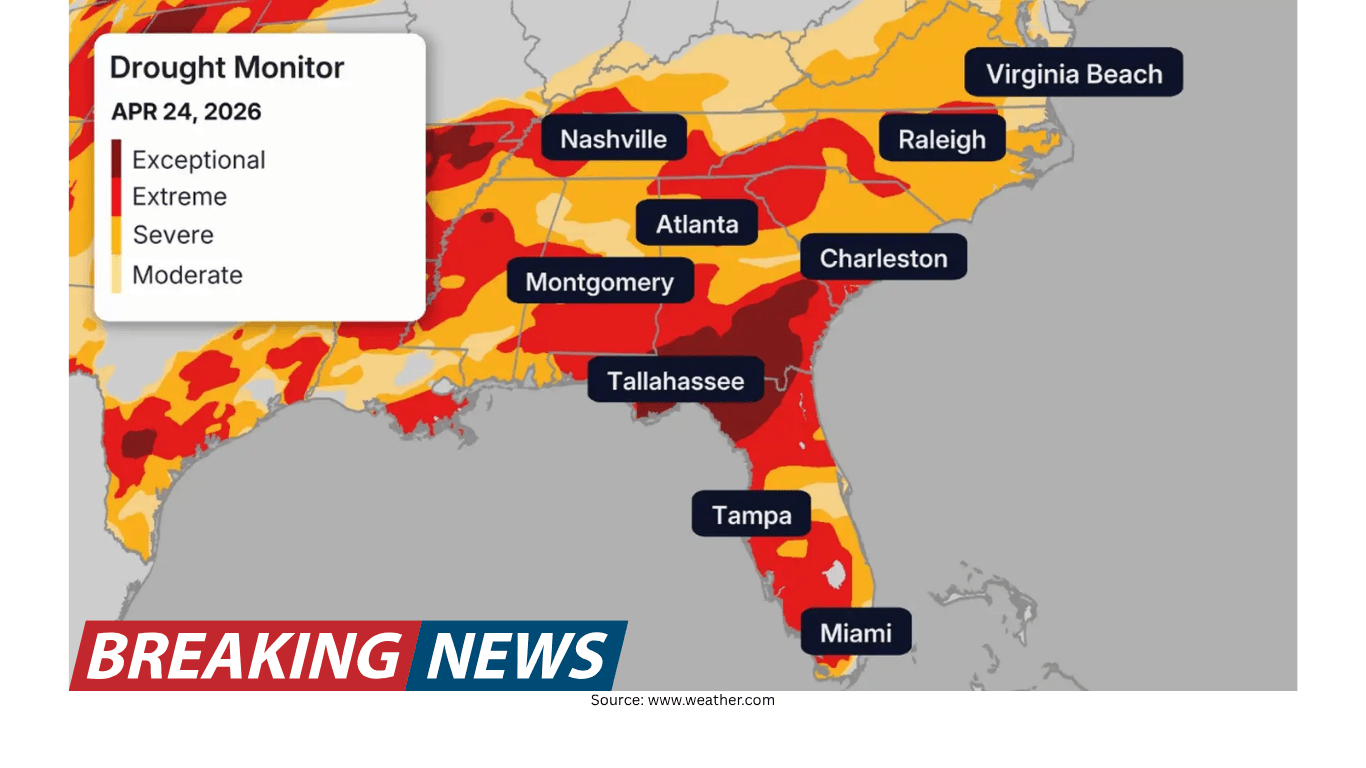
The drought has not only persisted; it has spread further and deepened in intensity. Regionally, the areas categorized as being in severe drought and extreme drought have each expanded by about 10%. That change may sound modest at first, but it is significant in a region where drought is already widespread.
In practical terms, nearly the entire Southeast is now dealing with some level of drought. Every part of Georgia, South Carolina, North Carolina, Virginia, Tennessee and Alabama is experiencing drought conditions. Arkansas and Florida are also essentially fully covered, with both states at 99% in drought. Florida, in particular, is experiencing its worst drought in 25 years.
With drought conditions so extensive, many communities are facing the same core issues at once: reduced soil moisture, heightened fire risk and increasing pressure on water resources. The breadth of the drought also means that relief is harder to come by. When dryness spans multiple states, it becomes less likely that isolated weather systems will deliver enough widespread rain to meaningfully reverse the overall trend.
La Niña set the stage for a warmer, drier winter
The current drought did not appear overnight. The region has been dealing with drought conditions since last fall, and the pattern that helped establish the dryness traces back to the past winter.
The United States was under the influence of a La Niña pattern this past winter. In the Southeast, that type of pattern typically favors a warmer and drier winter—conditions that were observed. As winter transitioned into spring, the dryness did not break. Instead, the region moved into a dry spring, compounding the deficits that had already accumulated.
This sequence is important because drought is often a cumulative problem. A dry winter can reduce groundwater recharge and leave vegetation and soils with less stored moisture. If spring then turns dry as well, the region can enter summer with depleted reserves, raising the likelihood that drought impacts will intensify as heat builds.
Many major cities are seeing one of their driest springs on record
The dryness has been widespread enough to show up in seasonal rankings for numerous population centers. Many cities are currently experiencing one of their top 10 driest spring seasons to date, according to the Southeast Regional Climate Center.
The list includes Atlanta, Savannah, Tallahassee, Charleston, Charlotte, Raleigh, Richmond, Memphis, Nashville and Montgomery. These are not small outposts; they are major hubs that influence surrounding regions. When large metro areas experience unusually dry seasons, it often reflects a broader regional pattern rather than a localized anomaly.
For residents, a “top 10 driest spring” can translate into tangible changes: browning landscapes, stressed vegetation, low soil moisture and, in some places, more frequent reminders about fire safety and water conservation. It can also affect planning for outdoor events and travel, particularly as summer approaches and the region’s heat and humidity typically rise.
Dryness dating back to last fall, with record conditions in multiple states
While spring has been notably dry, the longer-term context is even more striking. The Southeast has been dealing with drought conditions since last fall, and the period from September 2025 through March 2026 stands out in official records.
According to drought.gov, Georgia, North Carolina and South Carolina experienced record dry conditions for September 2025–March 2026, with records dating back to 1895. The same report notes that September–March was the second driest for Alabama, third driest for Florida, ninth driest for Tennessee and 10th driest for Virginia.
Those rankings underscore that the current drought is not just a short-term dry spell. When multi-month periods rank among the driest on record, it suggests that rainfall deficits have had time to accumulate across soils, streams and reservoirs. That makes recovery more difficult, because it takes sustained precipitation over time—not just one or two rainy days—to rebuild moisture levels across a large region.
Rain is possible in the near term, but totals look limited where drought is worst
There is at least a small near-term positive note: a pattern change is expected to bring some rain to the parched Southeast over the next seven days. However, the projected amounts are generally not large enough to erase the drought.
In the areas experiencing the most intense drought—such as Florida and Georgia—rainfall may total only a half inch or less. Parts of the Tennessee and Mississippi Valleys have higher totals in the forecast, generally in the 1 to 3 inch range. That would help, but it is not expected to be a “drought buster.” Arkansas could see a more substantial event, as models have hinted that parts of the state may receive up to 5 inches.
The uneven distribution of forecast rainfall is a key challenge. A few inches of rain in one corridor can improve short-term conditions locally, but if the most drought-stricken areas receive only light totals, the regional picture may not change much. In addition, drought recovery depends on how rain falls. A steady, soaking rain is generally more beneficial for soil moisture than brief downpours, which can run off quickly. The forecast described here points to some help, but not widespread, sustained relief.
Outlook: drought is expected to worsen into summer
Looking beyond the next week, the outlook is not encouraging for those hoping for a quick turnaround. The current projection shows drought conditions worsening as the Southeast heads into the summer months.
Places highlighted for potential worsening include Atlanta, Charlotte, Raleigh, Montgomery and Richmond. In a region already dealing with extensive drought coverage, a worsening trend can have compounding effects: higher fire danger, increased stress on vegetation and agriculture, and greater strain on water resources.
One reason drought can intensify quickly in summer is that higher temperatures increase evaporation and plant water use. When heat rises and rainfall is scarce, soils dry out faster. If the summer also turns out hotter than average, the drying can accelerate even more.
How much rain would it take to end the drought?
One of the clearest indicators of the scale of the problem is the amount of rainfall needed to eliminate the drought completely. According to NOAA, much of the Southeast would require 15 to 25 inches of rain over a three-month period to fully erase drought conditions.
That is a substantial amount of precipitation to deliver consistently across many states. It also helps explain why short-term rain events—such as a half inch here or a couple inches there—may provide temporary improvement without fundamentally changing the drought’s overall footprint.
In other words, the region is not just a little behind on rainfall. In many areas, the deficit is large enough that recovery would likely require a sustained wet pattern over an extended period.
Wildfire risk rises as dry fuels meet heat, low humidity and wind
As drought deepens, wildfire risk becomes a more prominent concern. Dry conditions can leave vegetation and other fuels more likely to ignite and spread fire. The risk can increase further if summer turns hotter than average in an already hot part of the country.
Several weather factors can combine to worsen fire danger: dry fuels, hot weather and low relative humidity. Gusty winds can also fan flames and help fires spread quickly. The combination of these elements can turn a small spark into a fast-moving fire under the wrong conditions.
For people planning to travel within the drought-stricken Southeast, wildfire preparedness is not just for those who live in traditionally fire-prone regions. Visitors who are not familiar with wildfires are advised to have a plan in case an evacuation becomes necessary. Knowing how to receive local alerts, understanding evacuation routes and being ready to change travel plans can be important when fire danger is elevated.
Soil moisture is very low, with implications for agriculture
Drought is not only about rainfall totals; it is also about what is happening in the ground. Soil moisture across the Southeast is very low, a condition that directly affects agriculture.
Low soil moisture can stress crops and make it harder for plants to access the water they need. It can also influence decisions about planting, irrigation and overall farm management. While the specific impacts can vary by location and crop type, the underlying issue is consistent: when soils are dry, agriculture becomes more vulnerable to heat and any additional lack of rain.
Because agricultural impacts can ripple outward—affecting local economies and supply chains—low soil moisture is one of the most consequential drought signals heading into summer.
Water restrictions are already occurring in parts of Florida
In addition to impacts on landscapes and agriculture, drought can affect water availability. Low water levels have led to some water restrictions, particularly in parts of Florida, according to drought.gov.
Restrictions can vary by community and are typically aimed at reducing non-essential water use while preserving supplies. When drought persists, such measures can become more common or more stringent, especially if rainfall remains limited and demand rises during hot weather.
For residents and travelers alike, it can be helpful to check local guidance on water use, especially in areas where restrictions are in place. Even small changes in daily habits can matter when water systems are under stress.
What this could mean for summer plans across the Southeast
With the region heading into summer under widespread drought, the impacts may show up in multiple ways. The most immediate concerns include the potential for hotter-than-average conditions, increased wildfire danger and continued stress on water resources and agriculture.
For those planning vacations or outdoor activities, the key is to stay aware of changing conditions. Drought does not automatically mean every day will be hazardous, but it can raise the likelihood of certain risks—particularly fire-related concerns when heat, low humidity and wind align.
At the same time, the scale of the rainfall deficit suggested by NOAA—15 to 25 inches over three months to eliminate drought in much of the Southeast—highlights that recovery is unlikely to happen quickly. Even if some areas see beneficial rain in the short term, the broader outlook still points toward worsening drought as summer approaches.
Key takeaways
- Drought conditions have expanded and intensified across the Southeast, with nearly the entire region in drought.
- Every part of Georgia, South Carolina, North Carolina, Virginia, Tennessee and Alabama is experiencing drought; Arkansas and Florida are 99% in drought.
- Florida is experiencing its worst drought in 25 years.
- La Niña contributed to a warmer, drier winter, followed by a dry spring that compounded deficits.
- Several major cities are experiencing one of their top 10 driest springs on record.
- Near-term rainfall is expected but may be limited in the hardest-hit areas; some locations may see only a half inch or less.
- The outlook indicates drought worsening into summer in multiple cities, and NOAA notes much of the region would need 15–25 inches of rain over three months to eliminate drought.
- Wildfire risk is expected to increase with dry fuels, heat, low humidity and wind; travelers should have an evacuation plan if visiting drought-stricken areas.
- Soil moisture is very low, affecting agriculture, and some water restrictions are in place in parts of Florida.